
Camp Springs City Directory Holdings
A Camp Springs city directory search is really a search through county history. Start with a surname, an old street name, or a nearby postal place. Then compare each printed entry with the next available volume. A listing can place a household in a particular period. It may carry a telephone-style notation or an apartment marker. Camp Springs keeps no municipal archive of its own. The useful shelves sit with Prince George's County institutions. City directories and related historical records can be checked side by side there. The same trail helps anyone tracing past residents of Camp Springs. It also suits anyone trying to find who lives on a street in Camp Springs by way of older listings.
| Collection | Years | Where Held | Access |
|---|---|---|---|
| Nelson’s Washington Suburban Directory | 1923 | PGCHS bibliography and county-history holdings | Confirm shelf or catalog availability |
| Polk’s Maryland-Washington Suburban Directory | 1930-31 | PGCMLS, PGCGS, and PGCHS collection references | Collection or staff route |
| Polk’s Maryland-Washington, D.C. Suburban Directory | 1954-55 | PGCMLS, PGCGS, and PGCHS collection references | Collection or staff route |
| Polk’s Laurel, Prince George’s County, Maryland | 1962 | Maryland State Archives, Mezzanine 1076 Polk; Google Books catalog | Archives original and digitized catalog/preview |
Treat these dates as collection anchors, not a continuous series. No official page names a complete PGCMLS reverse or criss-cross run, its years, or its shelf location. The 1962 Laurel volume is a nearby suburban source only. It does not prove that every Camp Springs road appears inside. Note: A missing name may reflect the volume's limits, an alternate place label, or a simply unlisted household.
Camp Springs City Directory, Not City Hall
Camp Springs is a Census Designated Place, not an incorporated municipality. There is no municipal clerk here. There is no city court, no city staff roster, no city cemetery office, and no city archive. That changes the first call. County and state custodians hold the official material. The library system, the historical society, and the Maryland State Archives keep the historical layer. A search labeled "Camp Springs city records" can miss the real sources entirely. That happens if it leaves out Prince George's County and the nearby postal names.
The county route matters when a directory clue needs confirmation. A printed address can lead to assessment material, a recorded deed, a probate file, or a newspaper notice. Each source answers a different question. For current address-keyed records, use the separate Camp Springs Street Directory path. Do not treat an old listing as a current household record.
Camp Springs City Directory Room
The Prince George's Room at the Hyattsville Branch is the most practical historical starting point. Nothing circulates from it. The room combines directories with newspaper microfilm. It also holds Sanborn microfilm, assessment books, historic court proceedings, genealogical periodicals, and historic-house photographs. Use the library catalog and try an asterisk where useful. Filter the assigned branch to Hyattsville Branch or Prince George's Room Collection. Staff consultation is part of the access route whenever a catalog entry does not make a directory's coverage clear.
The room lists a microfilm and microfiche reader. PGCMLS Discovery Suite, meanwhile, points to branch-only Ancestry Library Edition. It also points to remote HeritageQuest access with a library card and PIN. Newspapers can test a name, a road, a marriage notice, an obituary, or a move. The local fallback is microfilm and staff help rather than any Camp Springs-only obituary database.
Check the Prince George's Room collection and consultation route before planning a shelf search.

The room's local-history setting explains its value. A directory search can continue into newspapers, maps, and assessment material without leaving the same stop.
1962 Camp Springs City Directory Lead
The 1962 R.L. Polk & Co. Laurel volume is a documented historical lead for the county area. The Maryland State Archives directory guide names the title and its original Archives location. The digitized catalog identifies R.L. Polk & Co. of Richmond, Virginia, as the publisher. The volume is useful for testing a surname, an address form, or nearby suburban context. It is not a shortcut to a blanket Camp Springs conclusion. The book is Laurel-centered, so coverage must be read page by page.
The Google Books catalog for the 1962 Polk's Laurel directory supplies the title, year, publisher, original-copy note, contents, and a preview route.
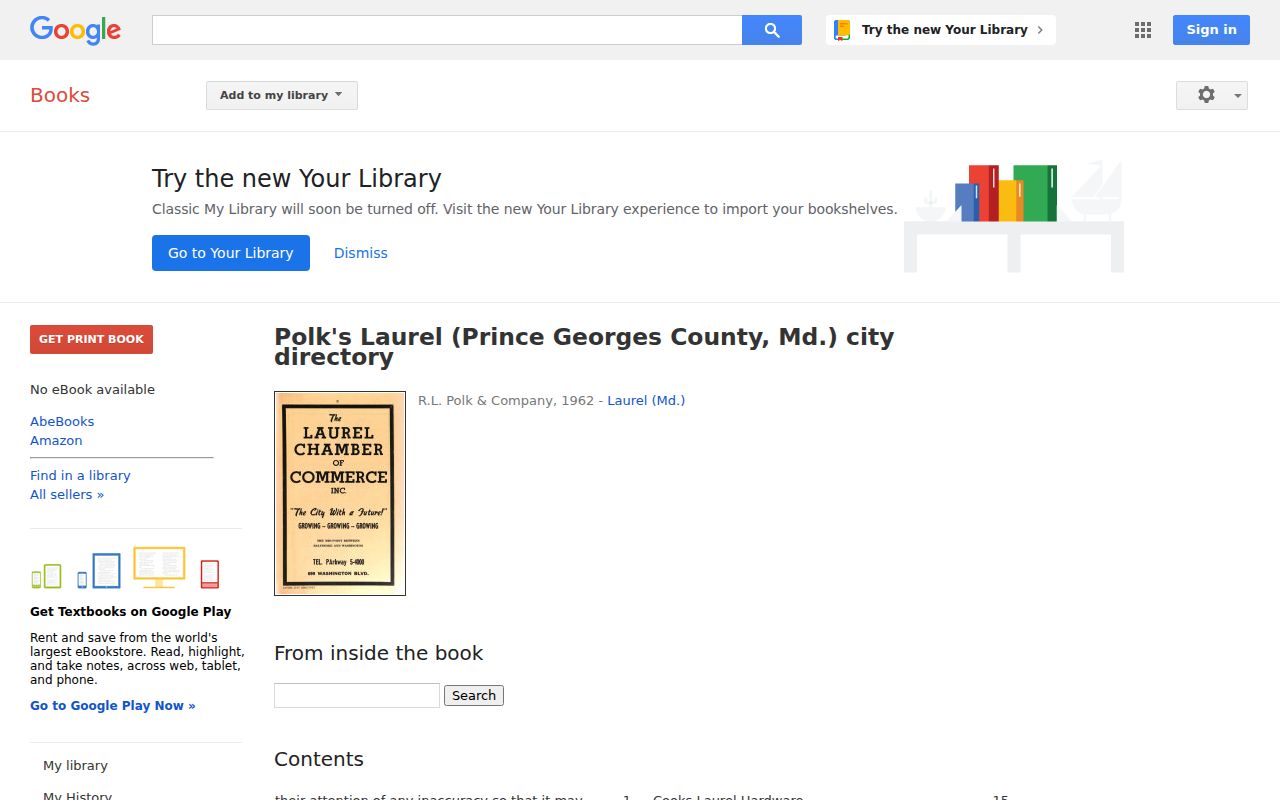
The catalog proves a known holding exists. The printed pages and the Archives original remain the place to verify a name, address, or abbreviation.
Reading Camp Springs Directory Entries
A directory entry is a printed snapshot, not a modern contact record. The accessible 1962 Polk preview shows surname and given-name styling, address notation, a Tel marker, an h home marker, an apt marker, and shortened occupation or organization language. Transcribe what is printed first. Interpret after. A spouse, telephone, business address, owner or renter mark, and widow notation may appear in some directory runs. Not every entry carries every field.
| Name line | Surname, given name, middle initial, spouse reference, or separate household line where printed. |
|---|---|
| Address line | House number, street, apartment or room notation, and a possible business address. |
| Telephone notation | A printed Tel marker or number when the volume includes one. |
| Household marker | h, apt, and other marks whose exact meaning belongs in the volume’s front matter. |
| Context fields | Occupation, organization shorthand, owner/renter or widow notation when the particular volume supplies it. |
- Criss-cross directory
- An address-ordered section, if the collection has one, that can be read by street instead of surname. No complete Prince George’s run has been verified.
- Householder index
- A name arrangement used to identify the person or household linked to a printed address.
- Abbreviation key
- The volume’s own front-matter guide to printed short forms. Check it before expanding h, Tel, or similar marks.
The preview does not display the full abbreviation key, and no unrestricted scan of that key is available there. Copy an unclear mark into your notes unchanged. Resolve it from the physical volume when you can.
Camp Springs City Directory Companions
A bare line in a residents directory often hides a story. The Prince George’s County Historical Society DeMarr Library and Archives holds the material. That material tells the story. Its shelves carry about 6,000 volumes. They also hold maps, archival photographs, journals, newspapers, community guides, and yearbooks. There are also files on places, events, and individuals. The collection sits at the Greenbelt Library, 11 Crescent Road, Greenbelt. Research access is free, and copying costs only a nominal fee. Saturday access and weekday appointments are described on its pages. Visitors should confirm current hours before traveling.
Yearbooks in the accessible holdings span roughly 1930 to 2006. A yearbook can tie a name to a school year. It can also link a photograph, an activity, or a neighborhood. Newspaper microfilm can supply a death notice, a marriage notice, or word of a move. None of these proves a current address, of course. The county publishes no complete Camp Springs obituary index and no official chamber member directory. Want local context behind a printed name? Review the DeMarr Library and Archives holdings and appointment information.

The county files, maps, guides, and yearbooks at the historical society fill in what a residents directory alone cannot say about Camp Springs.
Camp Springs City Directory Gaps
Some gaps deserve a plain warning. Camp Springs has no full municipal directory, no complete reverse-directory series, no municipal archive, no named local obituary index, and no city cemetery database. Searches may need Prince George’s County, Suitland, Temple Hills, or another nearby label instead. A missing surname can mean a rural road, selective circulation, an alternate address form, a publication gap, or a household that was simply never listed.
Work around the gaps step by step. Search the library catalog first. Ask Prince George’s Room staff about address-section holdings. Schedule a PGCHS visit when the question is historical. Maryland State Archives guides and FamilySearch images open older land, probate, marriage, and guardianship material. A narrow Maryland Public Information Act request can seek a county-held historical or administrative record, but it cannot force an agency to build a directory that never existed.
Note: The lack of a cataloged reverse run is a research gap, not proof that no address section exists anywhere.
Camp Springs City Directory Timeline
The known runs still form a useful set of time markers around Camp Springs, even with uneven local coverage. Read them beside county land, probate, newspaper, and census evidence for the fullest picture of a household.
- 1923: Nelson’s Washington Suburban Directory is identified in county-history sources.
- 1930-31: Polk’s Maryland-Washington Suburban Directory supplies a later suburban snapshot.
- 1954-55: Polk’s Maryland-Washington, D.C. Suburban Directory adds another documented run.
- 1962: Polk’s Laurel, Prince George’s County, Maryland is held at the Maryland State Archives and appears in the Google Books catalog.
- 1930-2006: PGCHS reports county and Washington-area yearbook holdings across this broad period.
Tracing Camp Springs City Directories
Trace one household with a dated log. Before moving between volumes, record the exact surname spelling, road, direction, suffix, unit, postal city, and ZIP. That discipline pays off in Camp Springs. Old entries may use a nearby postal place or only the county. Keep the census calendar in mind too. The 1950 count is the latest fully public decennial census, released in 2022. And 1960 stays closed until 2032 under the ordinary 72-year rule. A 1962 directory can bridge that stretch, but it remains an irregular commercial publication rather than a complete enumeration.
- Search the newest accessible directory’s address section, if one exists, and then its alphabetical section for the surname, spouse, telephone, or address clue.
- Move backward one volume at a time. Log first appearance, address changes, printed home or business marks, and the year the name disappears.
- Pair the directory years with the public census schedule. Use 1950 for household evidence and treat 1962 as an intervening directory snapshot, not a census substitute.
- Test the pair with a deed or SDAT record, newspaper notice, yearbook, probate file, church or cemetery source, depending on the question.
- Keep each volume, page, printed abbreviation, and repository in the log so the result can be reproduced.
A vanishing entry can mean many things. A move, a death, a changed printed name, a road change, or an unlisted household could all explain it. An absent volume could too. No single disappearance settles the question. Probate evidence helps where an estate trail begins. PGCMLS newspapers serve as the local option when a dated notice is needed. The historical shelf points to leads; original records and corroborating sources build the stronger conclusion.