
Camp Springs Resident Lookup Records
Maryland publishes no open name-to-current-address directory. A Camp Springs resident lookup gets stronger when it stacks record types together. It works best with two or three official sources. Label each result by its role. A property card may name an owner or a mailing contact. A voter result confirms a registration for a person whose identity fields check out. A court index identifies a case party. Vital, probate, license, and historical sources each answer different questions. Keep those roles separate. That is what turns scattered hits into a defensible answer about a Camp Springs resident.
| Record | What It Confirms | Where | Access |
|---|---|---|---|
| Real-property card and deed | Owner, tax mailing contact, premises, PAN, deed reference, parcel details | SDAT Real Property Search and MDLandRec | Public search; land images require the portal account route |
| Voter registration | Current registration status, districts, and election information for a matched person | Maryland Voter Lookup | Identity fields and CAPTCHA required |
| Court party index | Party name, case number, court, dates, status, and public summary details | Maryland Judiciary Case Search | Public summary; files and restricted material follow court rules |
| Vital record route | Eligible certificate, verification, or older archival record | Prince George’s County Health Department, Maryland DVR, and Maryland State Archives | Recent records are restricted by statute |
| Probate or entity record | Estate role, filing trail, entity status, or license category | Register of Wills, MSA, FamilySearch, Business Express, or Labor | Category-specific search and request rules |
Start from a known parcel whenever ownership is the real question. Save the PAN, deed book and page, and legal description as you go. Record the premises address and mailing address too. The voter tool belongs first only when you need a permitted status confirmation. It also works only if you can meet its identity fields. A court search works as a party cross-check, never as proof of where someone lives. For a historical question, the better opening record often differs. A dated directory, newspaper, yearbook, or probate image is often the stronger starting point in a Camp Springs resident lookup.
Camp Springs Resident Record Roles
Decide what a record must establish before typing a name. SDAT's public form asks for a county and a search method. It then offers address, account, map/parcel, and sales modes. There is no public owner-name browse and no ZIP-only browse. A tax mailing address can differ from the premises. So the two should not be conflated. MDLandrec then ties an owner or transfer to a recorded instrument. It does this through grantor and grantee names, recording date, instrument type, book and page, legal description, and prior reference.
For an heir, the Register of Wills, the Maryland State Archives probate series, and FamilySearch probate images can surface a decedent, personal representative, heirs, petition, inventory, account, and dates. A historical person may surface differently. Try date-bounded directories, PGCMLS newspaper microfilm, PGCHS yearbooks, or county materials. Label every hit as owner, historical resident, party, heir, licensee, or entity contact. That discipline keeps one same-name result from hardening into an identity claim.
Camp Springs Resident Voter Status
Maryland's state voter lookup confirms status; it is not a browseable resident roster. The form requires a first name, last name, date of birth, and a five-digit ZIP. Street number and middle initial are optional. CAPTCHA may appear. A match can return current registration. It can also show polling place or districts, local board information, ballot status, a sample-ballot route, or a duplicate-card route. A no-match is just that. It is not proof a person fails to live in Camp Springs.
The county tool takes an eight-digit date of birth plus ZIP. A voter ID works as an alternative. The tool states that its current information is updated weekly. Neither interface publishes a list of everyone at an address. Full voter-file access is a separate request product. It is governed by Election Law §3-506, COMAR 33.03.02, product selection, an electoral-purpose oath, and use restrictions. Use the Maryland Voter Lookup only with the required identity details. Your purpose must be one the official service allows.
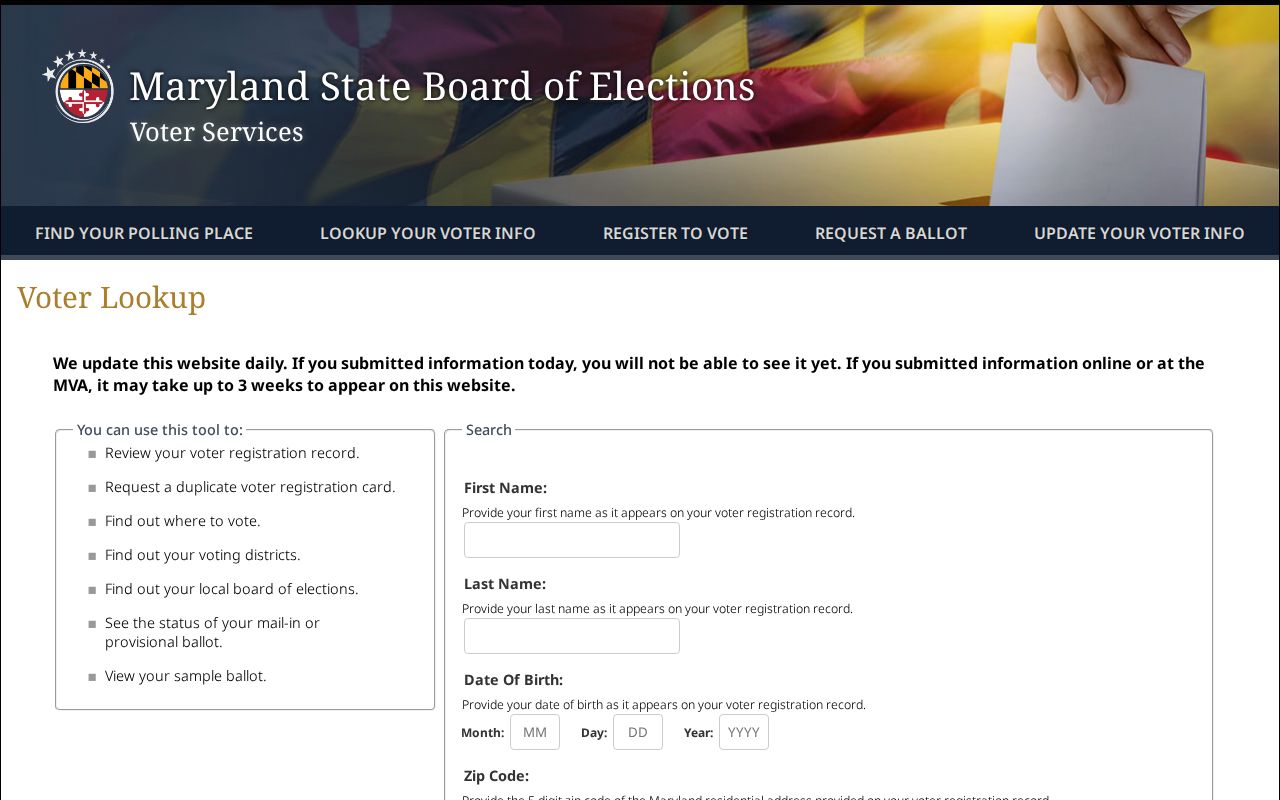
The state form's required fields explain the design: it confirms one person's status rather than exposing an open name list. The Prince George's County voter lookup takes the county's date-of-birth and ZIP route, or a voter ID.
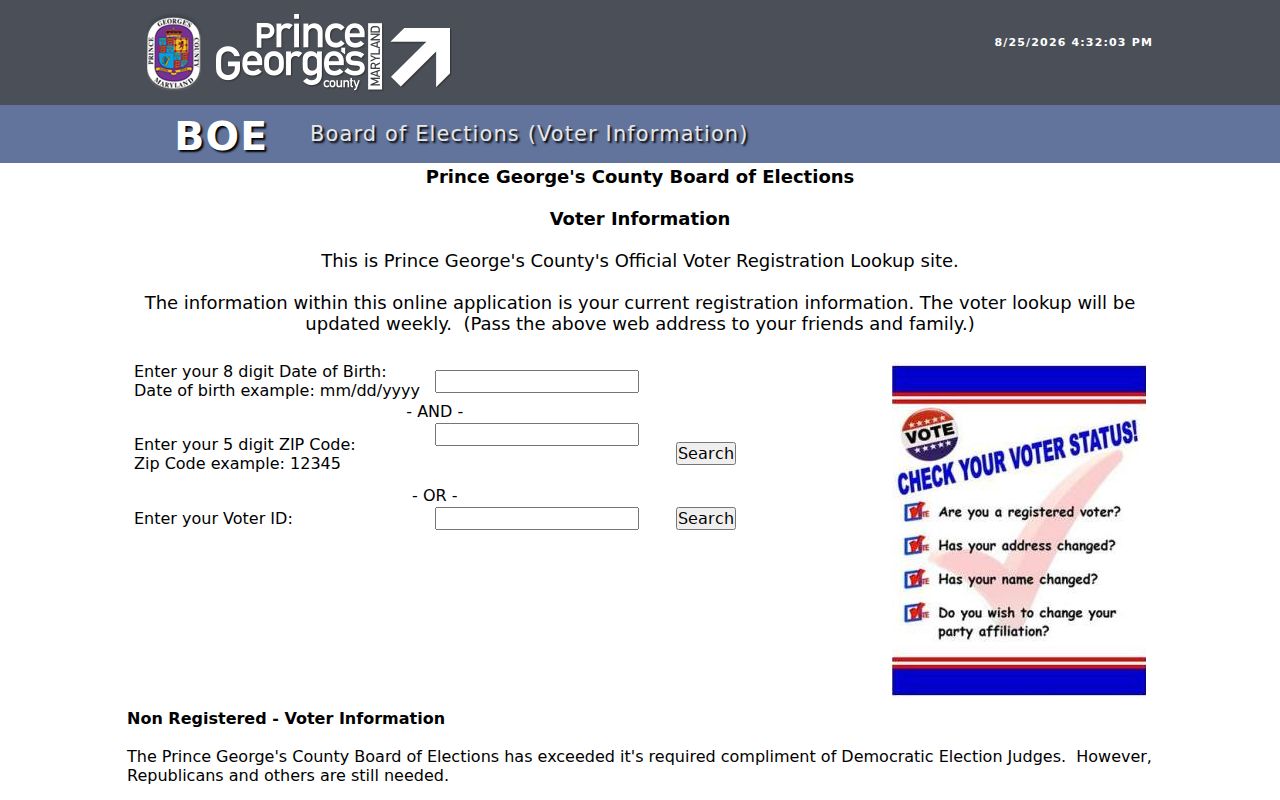
Treat the county interface as a separate current-status path, never as a public by-street directory.
Camp Springs Case Party Matches
Case Search tests a legal-party name. It does not locate a resident. Accept the portal's acknowledgement, open Party Search, and enter an exact last name or a partial value ending in % after at least the first character. First name is optional and can be partial too. When the portal offers filters, narrow by Prince George's court, case type, party role, and filing date. Those steps cut same-name noise and help you stay under the 500-result ceiling, past which only the first 500 matches may come back.
| Last and first name | Exact by default; a final % can make a partial search. The symbol cannot start or sit inside a word. |
|---|---|
| Court and type | Use the Circuit or District selection and category filters to narrow a party match. |
| Date and party role | Use available date and role controls to distinguish people with the same name. |
| CAPTCHA and results | Current CAPTCHA prevents automated querying. Clear or Reset removes fields; result columns can be sorted. |
The redesigned integrated Case Search & Record Portal launched in March 2026. The front door changed; the basic limit did not. Web results remain an informational summary. Older coverage varies by court and category. That older coverage begins around January 2006. Recheck live field order and portal notices before trusting any current screen.
Verifying a Camp Springs Resident
Verification comes from details that belong to the same person in the same role. Anchor a parcel question on the property card, not a bare name. From there, a resident lookup moves from the premises to the recorded reference, checks any court-party result as its own legal record, and uses a vital or probate path only when the access rule allows. A historic directory can enrich an old-address trail. It should never be converted into a current contact record. The Camp Springs City Directory collection holds that historical shelf.
- Search a known Camp Springs premises in SDAT. Preserve the PAN, legal description, transfer information, owner name, deed book/page, and the separate tax mailing contact.
- Use the deed reference in MDLandRec and read the recorded instrument. Compare grantor/grantee names, recording date, and prior reference rather than assuming an owner is an occupant.
- Run Case Search only as a party cross-check. Compare name variants, middle initials, suffixes, court, case number, date, party role, and disposition before treating a result as relevant.
- For an eligible vital or estate question, use the matching custodian and application route. Request a certified copy or inspect the original file only when the office permits access.
- Docket
- The court’s running list of case events, such as filings, hearings, document names, and calendar entries.
- Index versus image
- An index supplies searchable summary fields. The original image or file may contain the document itself and can follow a separate account, clerk, or access rule.
- Certified copy
- A copy issued or authenticated by the responsible office for a record that the requester is allowed to obtain.
A public case record carries real substance. Case Search results can list the case number, the court, and the case type. The status and filing date appear too. Parties and their roles show up as well, along with docket or calendar entries and document names. A charge, claim, or disposition summary often rounds out the file. The online record may leave out a document or a protected category, though. Keep the case number handy before asking a clerk for inspection or copies.
Camp Springs Vital Record Limits
Vital records sit in a separate Maryland system rather than with a Camp Springs registrar. For local service, the Prince George's County Health Department takes appointments. It serves Maryland births after 1939 and deaths after 2015. Maryland DVR covers statewide certificates and verifications for its periods. The Maryland State Archives holds the historical material. An index entry is only a research lead. It is not identity proof or a certified document.
State Government §9-1015 closes birth records for 100 years and death records for 10 years. Birth records past 100 years, death records past 10 years, marriage licenses, and absolute divorce or annulment records are unrestricted at the Archives. Access remains subject to the statute and agency procedures. Health-General §4-217 and COMAR 10.03.01.08 set the rules on eligible applicants. They also govern direct or tangible interest, identification, and copies. Submit an application with event details and required identification. An MPIA request cannot bypass those rules.
Camp Springs Consent Search
Birth-family questions have an official consent-based route. Maryland DHS Adoption Search Contact and Reunion Services combines ASCARS, the Mutual Consent Voluntary Adoption Registry, and a Confidential Intermediary search. Adult adoptees, birth parents, and birth siblings all qualify. The state service charges no fee, though a private intermediary may. The process honors a person’s choice not to be contacted. Adoption files stay sealed except as authorized.
The DHS application asks for identifying and placement information. It also requests contact details, agency or case and decree information, a reason for the search, and an alternate contact. A signature, photo ID, and notarized consent are needed where required. Submit it through the program’s linked form. You can also mail it to the DHS Adoption Search Contact and Reunion Services unit. That formal path is safer than piecing together protected family information from unrelated public records.
Camp Springs MPIA Records
The Maryland Public Information Act, General Provisions §§4-101-4-601, opens the door to public records. It does not force an agency to answer a general question about a person or build a fresh resident list. Send a request to the custodian who actually holds an existing, non-exempt record. Name the record, the date range you want, and whether you prefer to inspect it or get copies. If part of a file is confidential, ask for the segregable public portions.
An agency normally decides within 30 days. If it cannot answer inside 10 working days, it must send an estimate, the reason for the delay, and the likely fees. The first two hours of search and preparation are free under §4-206, and a public-interest waiver may apply. A denial should state its legal basis and the route for review. For a Camp Springs lookup, MPIA suits one specific county-held record rather than a broad name search.
Camp Springs Record Privacy Limits
Often the right answer is confidentiality. Maryland Safe at Home exists for eligible survivors and threatened individuals. It provides a substitute address with mail forwarding. A Camp Springs record showing an ACP address is not an error to chase down. Some records stay closed by design. Protected voter categories, restricted vital material, and sealed or expunged court matters are not gaps a resident lookup should try to slip past. Adoption files and private motor-vehicle data are the same. Contact the custodian instead for any correction, privacy, sealing, or program question.
Lawful use. Use a Camp Springs resident lookup for personal, lawful research and source verification. Never use names, addresses, or record details to stalk, harass, intimidate, or harm someone.
Take a record that looks wrong back to the office that controls it. Elections handles protected-voter treatment. The Secretary of State handles ACP. Vital records handles certificate rules or corrections. The court clerk handles file access. SDAT and land records handle parcel information. A protected address or a closed certificate is a stopping point. It is not an invitation to search around the safeguard.