
Camp Springs Previous Residents by Era
Pick the era first, then pick the record that speaks to it. Prince George's property and land records give the strongest spine for a parcel. They also cover every conveyance tied to it. A directory, newspaper, or census entry can supply a person or household at a known date. Yet each source has gaps of its own. One trap deserves mention. Camp Springs material may hide under Suitland, Temple Hills, Morningside, or Prince George's County. It may also hide under a road name. Keep the exact wording a source uses. Only then decide two records truly point to the same address.
| Source | Years it covers | Where held | What it shows |
|---|---|---|---|
| Prince George’s land records | County series from 1696; electronic groups from 1950, 1995, and 2003 | Land Records Division, MDLandRec, and Maryland State Archives | Conveyances, legal descriptions, mortgages, releases, and prior references. |
| SDAT parcel card | Current account with displayed selected transfers | Maryland SDAT | Current owner, premises and mailing fields, parcel identifiers, and deed references. |
| Suburban directories | 1923; 1930–31; 1954–55; 1962 nearby Laurel volume | Library, historical society, and archive collections | Dated name, address, telephone, and household clues where coverage is present. |
| Federal census | 1790–1950 public; 1960 expected in 2032 | NARA, library databases, and research collections | Household composition, relationships, and other recorded census fields. |
| LookSee permits | Momentum-era records; licensing began October 13, 2020 | County DPIE portal and office channels | Construction, alteration, inspection, or enforcement dates and references. |
| Probate material | Maryland collection 1796–1940 plus later county files | Maryland State Archives and Register of Wills | Decedent, representative, heirs, inventory, or estate chronology. |
Match the entry point to the question. A recent transfer starts with the SDAT address result and its cited deed. An older address may carry an uncertain modern number. Begin with the lot, block, plat, or legal description instead. A household question pairs a dated directory or newspaper item with the right census window. A thin online result never means the record trail is empty. Older work belongs at the Land Records counter, the Maryland State Archives, and library microfilm. Reference staff there handle these searches daily.
Camp Springs Deed Index Cutovers
Prince George's County keeps a deep land-record history. The search interface is not one continuous modern database, though. Maryland State Archives guides date the county land series to 1696. Historical court-land records reach 1696–1851. Circuit and electronic indexes span 1840 onward. The county's electronic groups begin with COTT in 1950. CAIS followed in 1995, and ELROI/current began in 2003. Those cutoffs matter. They tell a searcher when a book-and-index lookup becomes necessary. A current screen alone should not be trusted as complete. The Maryland State Archives land-record research aid lays out the older-index route. It helps anyone whose modern deed search hits a boundary.
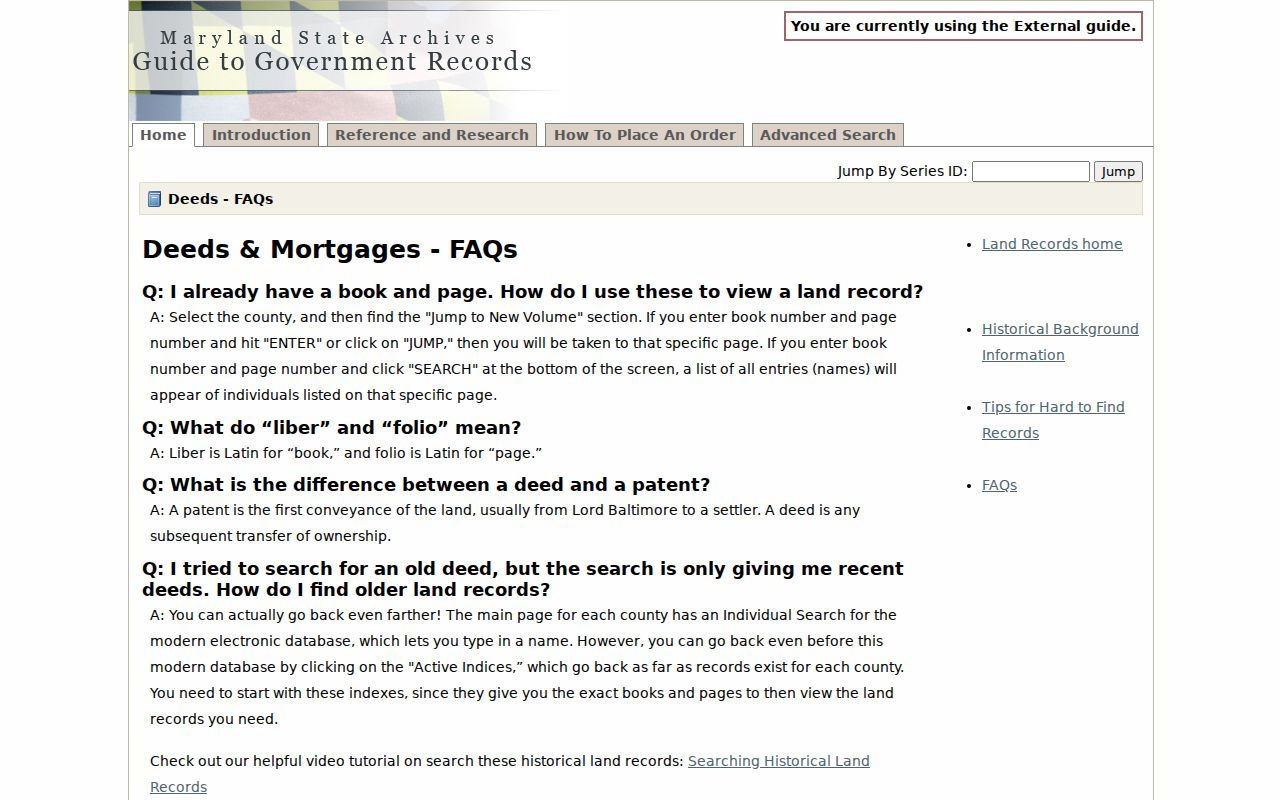
The same research aid restates the house-history rule that matters most: carry the county, book, page, party names, and legal description along as the trail leaves an electronic result and enters older series. These cutover dates are not trivia. A 1950 COTT record, a 1995 CAIS record, and a 2003 ELROI record may each demand a different search path and a fresh read of the cited book and page. Note: The electronic groups supplement rather than replace the older county books and scanned grantor and grantee indexes.
Trace Camp Springs Deed Transfers
Ownership is one layer of an address history. But the deed chain is its legal spine. Begin with the current SDAT property card, not a general name search. SDAT offers no public owner-name search. Its address result supplies the owner of record, premises and mailing fields, account or PAN, map, grid, and parcel, subdivision and lot details, the deed reference, transfer date, and selected prior transfer. The deed image then supplies the fuller evidence needed to work backward.
- Search the full address in SDAT and save the account or PAN, map/grid/parcel, legal-description fields, deed book/page, transfer date, and prior reference.
- Open the cited book and page in MDLandRec. Read the grantee, grantor, instrument type, legal description, date, consideration when shown, and prior reference.
- Search the seller as a grantee, narrowing with Prince George’s County, an approximate date range, party type, document type, and known book/page details.
- Repeat the earlier deed reference, retaining every spelling variant and recording the source date rather than relying on a copied name alone.
- When the chain reaches a pre-electronic group, use MSA’s combined-series guides and scanned grantor/grantee indexes, then contact the Archives or Land Records Division for the book/page route.
- Grantor / grantee
- The grantor transfers an interest in property; the grantee receives it in the recorded instrument.
- Chain of title
- The sequence of recorded transfers and related instruments used to trace an ownership history.
- Legal description
- The lot, block, subdivision, metes-and-bounds, or other land description that keeps the record tied to the parcel when an address changes.
- Criss-cross directory
- An address-section directory, if one exists for the volume and place being researched, arranged to help connect an address with a dated listing.
Camp Springs Legal Description Trail
Old searches often stall the moment a street name disappears. That is the cue to drop the modern address. Pick up the property's legal description instead. A deed may name a subdivision, lot, block, or plat rather than a street number. SDAT's map/grid/parcel and subdivision fields help here. A deed's book and page plus its prior reference also help. Together they let you set that older language beside the present parcel. Plats.net and recorded subdivision plats can supply the mapped link. A plat alone never proves current ownership, though.
SDAT's own search help warns that directions, suffixes, punctuation, alternate street names, numbered streets, unit formats, and missing street numbers can all change a result. The county centerline layer carries an alternate-name field and community-side fields. The county publishes no Camp Springs street-renaming or renumbering date, however. So test both the old and modern forms. If the evidence still conflicts, do not force a match. Instead, record the legal description and nearby cross streets in your log.
Camp Springs Previous Residents in Directories
Directories are date-bounded snapshots, never continuous occupancy records. The county-area shelf to check includes Nelson's Washington Suburban Directory for 1923. It also includes Polk's suburban volumes for 1930–31 and 1954–55. A 1962 Polk's Laurel directory rounds it out. The Laurel volume is a nearby suburban resource. It is not evidence that a Camp Springs road appears inside it. No complete Camp Springs reverse-directory series or verified address-section year range exists in official form. So a shelf check and a talk with staff are essential.
A practical flow runs from the address form and legal description to a dated directory entry. It then moves to the nearest public census. From there it returns to deed, obituary, probate, newspaper, yearbook, or permit evidence. The 1950 census opened to the public in 2022. The ordinary 72-year rule holds 1960 back until 2032. That gap is exactly why a printed entry can be valuable without being conclusive. The collections and their repositories are described on the Camp Springs city directory page.
Camp Springs Past Resident Census
Federal census schedules open to the public through 1950 under the standard 72-year rule. Anything later stays closed. A dated street directory can bridge that gap, tying a mid-century Camp Springs address to a household clue. It never replaces the census record itself. Camp Springs may fail to appear in an index. Then search the county, nearby place labels, and the road name. Expect boundary and enumeration-district digging. The CDP label, the postal city, and the historical record label rarely line up neatly.
Treat each census listing as evidence of one moment. Household composition, age, relationship, and other schedule fields sit on a fixed date. Stretching it across uncovered years invites error. County directories, PGCMLS newspaper microfilm, and Maryland State Archives guides can fill the intervals. So can FamilySearch images. Confirm the original series and the Prince George's County jurisdiction first.
Camp Springs Permit Date Clues
LookSee Property Explorer takes a full reference number. It also accepts a street number paired with a street name. Results can include Momentum permits, licenses, inspections, and enforcement actions. A permit therefore dates when work or an administrative event touched a structure. It does not prove anyone lived there. Supporting plans or applications may stay closed to public guests.
Older ePermits can sit in a separate county system. Where deed history runs thin, record the address, the permit reference, and the event date. Then line that date up against the property record, a directory, newspapers, or archival maps. Some material has no online display. A narrowly framed Maryland Public Information Act request works as a fallback. DPIE, PGCMLS, PGCHS, and Maryland State Archives reference channels can also help.
Camp Springs Previous Residents After Death
Probate and obituary material can close out a historical household trail. It does so without sliding into a search on a living person. Prince George's estate records can name a decedent, personal representative, heirs, fiduciaries, and attorneys. They may also list addresses, inventories, accounts, and estate dates. The Maryland probate and guardianship collection spans 1796–1940. It holds roughly 1.58 million Prince George's images. Confirm the jurisdiction and the image through Maryland State Archives or the Register of Wills. An index entry alone is not enough.
PGCMLS microfilm carries newspapers, from notices and social columns to obituaries. The Prince George's County Historical Society's DeMarr Library keeps maps, photographs, and community guides. It also holds yearbooks, journals, and county-history material. No Camp Springs cemetery interment database or funeral-home name archive exists online. Address a request with the county. Include the decedent, an estate number if known, and the document sought. Detailed estate files may require the county office, a written request, or an in-person visit.
Limits on Camp Springs Past Residents
A prior deed proves one recorded transfer, not every occupant of an address. A parcel card names an owner or mailing contact. A directory prints a dated association. A census, probate file, newspaper, or permit carries its own date and purpose. Hold those limits in view. That matters above all when an old address carries a changed number, a different postal city, or a legal description standing in for a street line.
Lawful use. Use Camp Springs house-history records for family history, estate research, property curiosity, and other personal lawful purposes. Do not use a prior-address trail to stalk, harass, intimidate, or harm any living person.